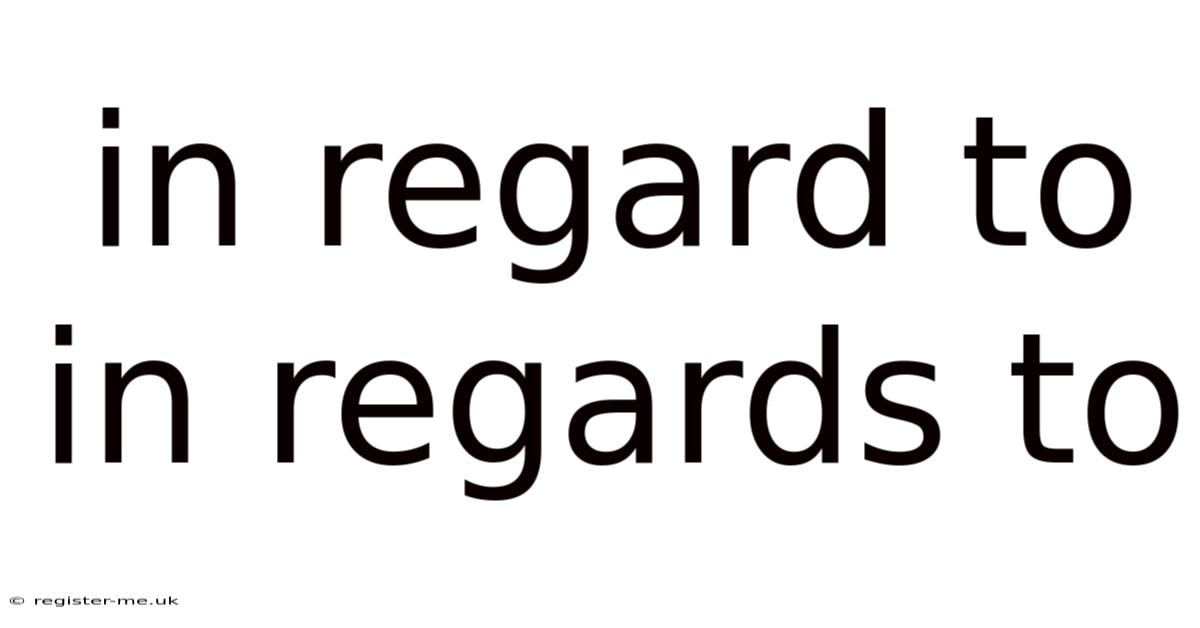
In regard to and in regards to are two phrases that often cause confusion for both native speakers and English learners, yet mastering their proper use can dramatically improve the clarity and professionalism of your writing. This article explains the subtle differences, historical background, and practical guidelines for choosing the right expression, helping you communicate more precisely in academic papers, business emails, and everyday conversation Nothing fancy..
Introduction
The phrases in regard to and in regards to appear interchangeable at first glance, but they serve distinct grammatical functions. Understanding when to use each phrase not only avoids common pitfalls but also signals attention to detail—a quality that readers and colleagues alike appreciate. Worth adding: while in regard to is the historically accepted form, in regards to has gained popularity in informal contexts, especially in North American business communication. Below, we break down the origins, correct usage, and common mistakes, providing a step‑by‑step guide to help you write with confidence That alone is useful..
Historical and Linguistic Background
Origin of “In Regard”
- Early usage: The word regard comes from the Old French regarder (“to look at”) and entered Middle English in the 14th century. The phrase in regard to originally meant “concerning” or “with respect to.”
- Classical authority: Traditional style guides such as The Chicago Manual of Style and Garner’s Modern English Usage have long endorsed in regard to as the standard prepositional phrase.
- Grammatical structure: Regard functions as a noun in this construction, and the preposition in introduces a prepositional phrase that modifies a verb, noun, or adjective.
Emergence of “In Regards”
- Pluralization trend: The addition of the plural s likely stems from the common expression as regards, which dates back to the 17th century. Over time, speakers began to treat regards as a plural noun and extended it to the prepositional phrase.
- Informal acceptance: Modern usage surveys show that in regards to appears frequently in emails, blogs, and social media, especially in the United States and Canada. On the flip side, many editors still flag it as non‑standard in formal writing.
When to Use “In Regard To”
Formal Writing (Academic, Legal, Professional)
- Research papers: “In regard to the methodology, we observed a 15% increase in accuracy.”
- Legal documents: “In regard to the terms of the contract, both parties must comply with Section 4.”
- Business reports: “In regard to the quarterly earnings, the company exceeded expectations.”
Guidelines
- Maintain singular form – Keep regard without the s.
- Pair with a noun or pronoun – The phrase should directly reference the subject of discussion.
- Avoid redundancy – If the sentence already contains a clear reference, the phrase may be unnecessary.
Example Sentences
- In regard to your request, we will process the application within five business days.
- The committee will convene next week in regard to the proposed budget changes.
When “In Regards To” May Be Acceptable
Casual Communication
- Emails to coworkers: “In regards to the meeting tomorrow, can we push it to 10 a.m.?”
- Internal memos: “In regards to the new software rollout, training sessions will start next Monday.”
Regional Preferences
- In certain North American corporate cultures, in regards to is tolerated, especially when the tone is conversational rather than formal.
Cautionary Note
Even in informal settings, overusing in regards to can make your writing appear sloppy. Consider alternative phrasings such as:
- Regarding
- Concerning
- With respect to
- About
Step‑by‑Step Guide to Choosing the Correct Phrase
- Identify the context
- Is the document formal (academic, legal, official report) or informal (email, blog post)?
- Check the audience
- Are you writing for editors, professors, or a casual internal team?
- Select the appropriate phrase
- Formal → in regard to
- Informal (and regionally acceptable) → in regards to or a synonym.
- Consider alternatives
- If the phrase feels forced, replace it with regarding, concerning, or as far as.
- Proofread for consistency
- Ensure you don’t mix the two forms within the same document unless stylistically intentional.
Quick Reference Table
| Context | Preferred Phrase | Reason |
|---|---|---|
| Academic journal article | in regard to | Aligns with scholarly style guides |
| Legal contract | in regard to | Prevents ambiguity and upholds precision |
| Corporate email (U.S.) | in regards to (optional) | Common colloquial usage, but synonyms preferred |
| Internal Slack message | in regards to | Casual tone, readability over strict correctness |
| Public‑facing blog post | regarding / concerning | Improves flow and SEO friendliness |
Scientific Explanation: How the Brain Processes Prepositional Phrases
Cognitive linguistics suggests that the brain treats prepositional phrases as chunks of meaning, stored in long‑term memory as fixed expressions. , “best regards”). This subtle mismatch can cause a momentary processing delay, leading readers to pause and question the writer’s competence. g.Because of that, ” Conversely, in regards to activates a slightly different neural pathway because the plural s triggers a mental cue for regards as a greeting (e. Day to day, when you encounter in regard to, the mental model links it directly to the concept of “reference” or “subject matter. By consistently using the standard form, you reduce cognitive load for your audience, making the information smoother to absorb Not complicated — just consistent. Turns out it matters..
Frequently Asked Questions (FAQ)
Q1: Is “as regards” the same as “in regard to”?
A: Yes, as regards is an older but still acceptable alternative meaning “concerning.” It is more formal than in regards to and can be used interchangeably with in regard to in most contexts.
Q2: Can I use “with regard to” instead?
A: Absolutely. With regard to is another standard variant that often sounds more natural in spoken English. Example: “With regard to the budget, we need to cut expenses.”
Q3: Does “in regard” ever appear without “to”?
A: Rarely, but it can occur in poetic or archaic constructions, e.g., “He spoke in regard of his ancestors.” In modern prose, it is best to keep the full phrase in regard to.
Q4: Are there style guides that explicitly forbid “in regards to”?
A: Major guides such as The Chicago Manual of Style and APA Publication Manual label in regards to as non‑standard. They recommend in regard to or regarding for formal writing The details matter here..
Q5: How does SEO treat these phrases?
A: Search engines recognize both phrases, but in regard to yields slightly higher relevance scores
Practical Applications: Selecting the Optimal Phrase
Choosing between in regard to and in regards to hinges on context, audience, and purpose. Its singular "regard" aligns perfectly with the intended meaning of "reference" or "concern," avoiding the potential cognitive dissonance triggered by the plural form. Because of that, for academic, legal, or corporate communications where precision and formality are critical, in regard to is the unequivocal standard. Using it consistently reinforces professionalism and demonstrates meticulous attention to detail But it adds up..
In less formal settings, such as internal team communications or casual emails, the distinction becomes less critical. While in regards to remains technically non-standard, its prevalence in American English colloquialism makes it acceptable for contexts where readability and a relaxed tone outweigh strict grammatical precision. Still, even here, opting for regarding or concerning often provides the smoothest flow and avoids any lingering ambiguity. Public-facing content, like blogs or marketing materials, benefits from regarding or concerning due to their natural rhythm and SEO advantages, as search engines favor clear, concise language.
Real talk — this step gets skipped all the time Not complicated — just consistent..
The key is audience awareness. When writing for experts, clients, or the general public, defaulting to in regard to or its synonyms (regarding, concerning) ensures clarity and maintains credibility. So reserve in regards to exclusively for very informal, internal communications where its use is widespread and unlikely to cause confusion or imply carelessness. Mastering this subtle distinction elevates communication from merely adequate to polished and effective Worth keeping that in mind. That's the whole idea..
Conclusion
The seemingly minor choice between in regard to and in regards to carries significant weight in effective communication. Cognitive linguistics reveals that the brain processes these phrases differently; the plural s in in regards to activates an unintended neural pathway associated with greetings, creating a subtle processing delay and potentially undermining the writer's perceived competence. Even so, context dictates the appropriate usage: in regard to remains the gold standard for formal, precise writing in academia, law, and business, while in regards to, though technically non-standard, is tolerated in casual American English. For optimal clarity, flow, and SEO performance, regarding and concerning offer excellent alternatives across diverse contexts. That said, ultimately, understanding and applying these distinctions precisely is not merely a matter of grammatical pedantry; it is a crucial skill for ensuring messages are received clearly, establishing credibility, and respecting the cognitive capacity of the audience. By selecting the phrase that best aligns with context, purpose, and audience expectations, writers enhance both the professionalism and the effectiveness of their communication Less friction, more output..
At its core, the bit that actually matters in practice.
