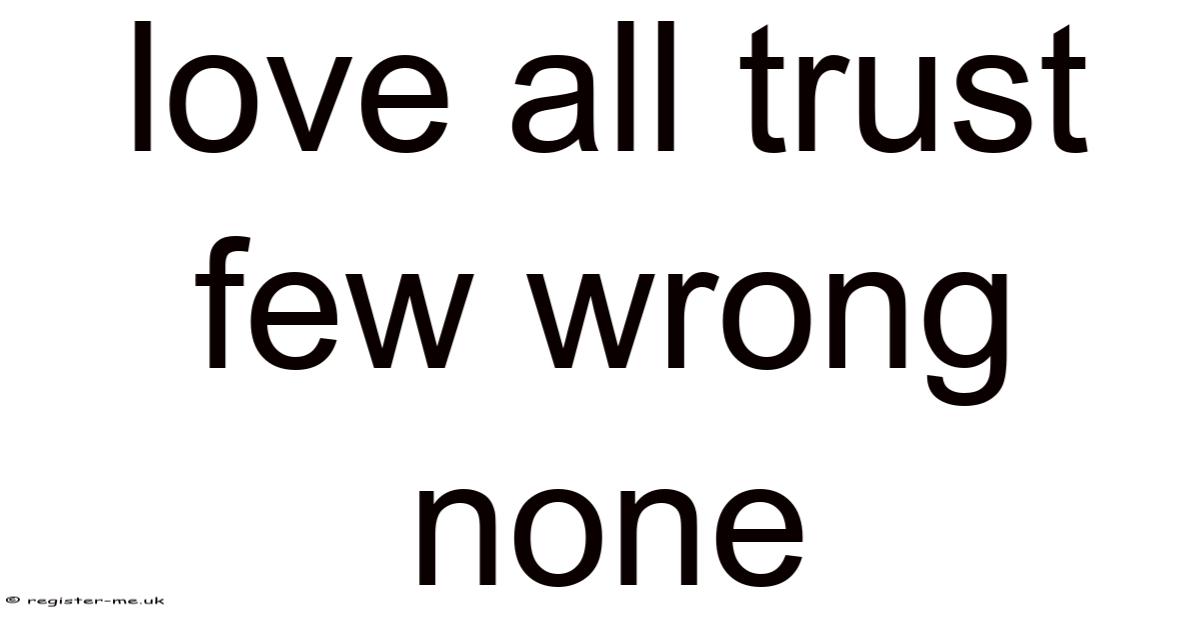
Love All Trust Few Wrong None: Navigating the detailed Balance of Human Connection
In a world often fraught with miscommunication, societal expectations, and the relentless pursuit of perfection, the notion of "love all trust few wrong none" emerges as a paradoxical yet profoundly valuable guiding principle. Consider this: at first glance, the phrase feels abstract, almost paradoxical, yet its essence lies in its ability to build resilience, empathy, and authenticity. At its core, this philosophy challenges us to reconcile the dualities inherent in human relationships: the tension between idealism and reality, the desire for certainty versus the acceptance of uncertainty, and the courage required to confront flaws while maintaining faith in the possibility of redemption. By exploring the nuances of this concept, we uncover a framework for understanding how trust, imperfection, and honesty intertwine to shape meaningful connections—both personal and collective.
Trust as the Foundation of Meaningful Bonds
Trust serves as the cornerstone upon which most enduring relationships are built. Yet, this concept often eludes us due to its inherent complexity. Trust requires not merely faith in another person’s integrity but also the acknowledgment of imperfections that define human nature. Consider a friend who occasionally fails to meet deadlines; their inability to always deliver may initially strain trust. On the flip side, trust does not demand perfection—it demands a willingness to accept that imperfection is inherent to life. In this light, trust becomes a dynamic process rather than a static promise. It involves consistent actions that demonstrate reliability, such as following through on commitments despite obstacles, or offering support during challenges. This process cultivates a reciprocal relationship where both parties contribute to strengthening trust over time That alone is useful..
Also worth noting, trust thrives in environments where vulnerability is met with acceptance. But when individuals feel safe to share their flaws, fears, or uncertainties without fear of judgment, trust flourishes. Because of that, this vulnerability, though daunting, is what transforms relationships from superficial exchanges into profound connections. Here's a good example: a partner who openly shares their struggles with anxiety may deepen trust by demonstrating that vulnerability is not a weakness but a testament to shared humanity. Think about it: similarly, a mentor guiding a student through setbacks can embody trust by prioritizing growth over immediate results. Here, trust is not the absence of flaws but the commitment to work through them together Not complicated — just consistent..
Embracing Imperfection: The Cost of Honesty
The pursuit of "love all trust few wrong none" necessitates a radical acceptance of imperfection. In a culture that often equates success with flawless outcomes, embracing imperfection becomes a radical act of courage. This involves recognizing that mistakes are inevitable and that growth stems from navigating them rather than avoiding them. Consider a colleague who makes a critical error in a project; instead of viewing it as a failure, acknowledging it as a learning opportunity allows for constructive dialogue and shared problem-solving. Such an approach fosters a culture of resilience, where setbacks are reframed as stepping stones rather than defeats.
Equally important is the recognition that "none" in this context does not denote indifference but rather a deliberate choice to prioritize empathy over judgment. Here's the thing — it means choosing compassion over criticism, even when faced with unpopular truths. This stance aligns with the principle that true trust is built on mutual respect, where both parties feel valued regardless of their shortcomings. Here's one way to look at it: a partner might admit they struggle with communication issues, not to undermine the relationship, but to invite collaboration in improving it. Such honesty, though uncomfortable, strengthens bonds by demonstrating a commitment to collective growth over individual ego.
The official docs gloss over this. That's a mistake.
The Power of Honesty in Reconciling Discrepancies
Discrepancies between expectations and reality often test the limits of trust. When individuals clash over differing perspectives or priorities, the challenge lies in maintaining trust while navigating these tensions. Here, "love all trust few wrong none" becomes a compass guiding how to address conflicts rather than avoid them. Rather than seeking to eliminate differences, the goal is to engage with them constructively. This might involve active listening, seeking common ground, or finding compromise that honors both parties’ needs. To give you an idea, a family dispute over financial responsibilities can be approached not as a battle but as a shared endeavor to find solutions that balance fairness and practicality Easy to understand, harder to ignore. Still holds up..
Honesty also plays a critical role in repairing trust after a breach. That's why when trust is damaged, acknowledging the fault without deflection allows for genuine reconciliation. This process requires humility, as it demands the courage to confront one’s own shortcomings while remaining open to others’ perspectives. Think about it: in such moments, the phrase “none” gains significance—not as a dismissal but as a reminder that accountability and growth are intertwined. The act of owning mistakes, even when difficult, often proves more restorative than deception ever could.
The Role of Self-Awareness in Sustaining Trust
A critical component of "love all trust few wrong none" is self-awareness. Without understanding one’s own flaws, biases, or emotional triggers, it is impossible to develop trust effectively. Self-reflection allows individuals to recognize patterns that may undermine their efforts to build rapport. To give you an idea, someone prone to overcommitment might inadvertently erode trust by failing to respect others’ boundaries. Acknowledging such tendencies enables proactive adjustments, such as setting clearer expectations or practicing patience.
Equally vital is the practice of self-compassion. Trust often requires patience, and impatience can erode it. Because of that, this self-compassion extends to others as well, ensuring that trust is nurtured through mutual respect and understanding. Plus, learning to accept that trust is a gradual process, shaped by consistent actions rather than immediate outcomes, allows individuals to remain steadfast in their commitment. When individuals prioritize their well-being alongside others’, they create a sustainable foundation for trust to flourish And that's really what it comes down to..
People argue about this. Here's where I land on it.
The Ripple Effect of Collective Trust
The impact of "love all trust few wrong none" extends beyond individual relationships to influence broader communities. When trust is prioritized, it fosters environments where collaboration, innovation, and mutual support thrive. In workplaces, educational institutions, or social groups, a shared commitment to honesty and integrity cultivates a culture of accountability and inclusivity. To give you an idea, a workplace that encourages open communication and admits mistakes openly often sees higher employee engagement and creativity. Similarly, communities grounded in trust can better address collective challenges, such as social cohesion or environmental stewardship.
This ripple effect underscores the interconnectedness of trust across scales. By modeling trustworthiness, individuals inspire others to adopt similar behaviors, creating a virtuous cycle. The collective strength derived from such a mindset amplifies its significance, demonstrating how personal choices can catalyze broader societal change That alone is useful..
Conclusion: Cultivating the Seeds of Trust
In essence, "love all trust few wrong none" is not a prescriptive rule but a philosophical stance that invites continuous reflection and adaptation. It challenges us to embrace the messiness of human experience while striving for connection amidst it. The journey requires patience, humility, and a willingness to confront discomfort—both in ourselves and others. Yet, through these efforts, we lay the groundwork for relationships that are resilient, authentic, and deeply fulfilling.
As we work through this path, let us remember that trust is not a destination but a
living practice. Still, it thrives in the spaces between grand gestures—in the daily choice to listen without agenda, to speak with integrity, and to extend goodwill even when certainty is absent. That said, this practice, rooted in the wisdom of loving generously, trusting judiciously, and withholding wrongful intent, becomes a quiet revolution. Day to day, it transforms not only our closest bonds but also the unseen architecture of our communities, fostering a world where connection is chosen over cynicism, and understanding is built brick by patient brick. In the long run, to live by these principles is to invest in a legacy of compassion that, once sown, continues to yield harvests of trust long after we are gone.
