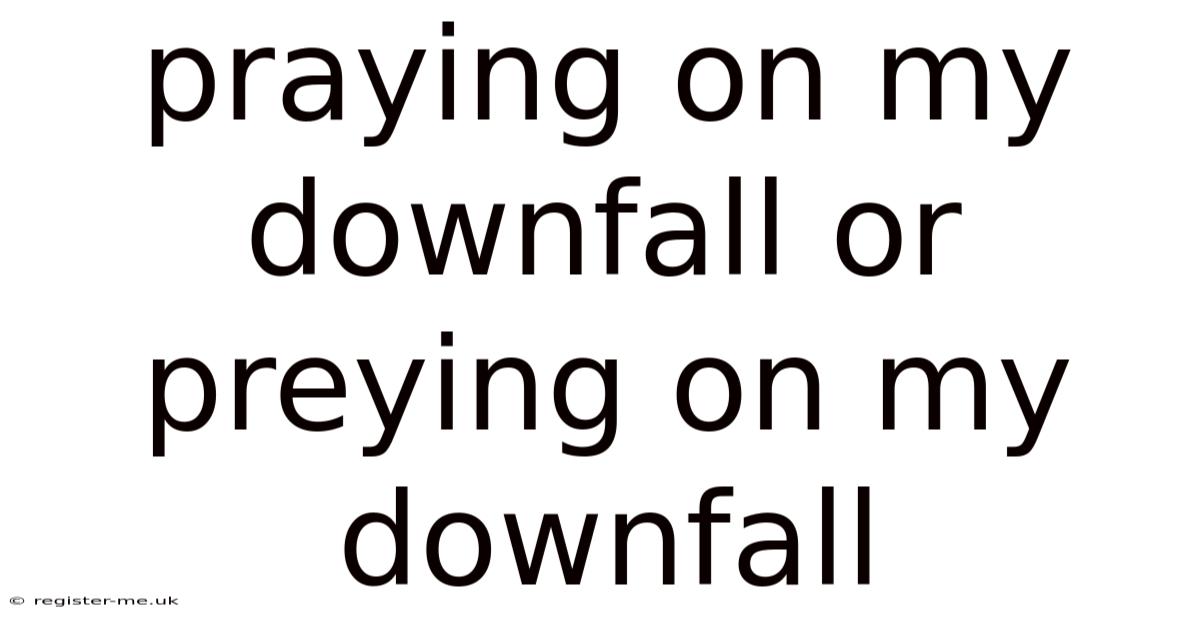
Understanding the Difference: “Praying on My Downfall” vs. “Preying on My Downfall”
Every time you hear someone say “they’re praying on my downfall,” the phrase can feel oddly comforting, as if the speaker is hoping for divine intervention to keep them safe. Although the two expressions sound similar, they convey opposite attitudes and intentions. In contrast, “preying on my downfall” carries a harsh, predatory connotation, suggesting that someone is actively waiting to exploit a weakness. This article unpacks the origins, grammatical nuances, and real‑world applications of both phrases, helping you recognize when each is being used—and how to respond effectively.
Introduction: Why the Confusion Matters
Language evolves quickly, especially on social media where brevity and wordplay dominate. A single typo or an intentional pun can shift a sentence’s meaning dramatically. Misunderstanding praying versus preying can lead to:
- Misinterpreting motives – assuming a friend is supportive when they’re actually scheming.
- Damaging relationships – reacting with gratitude instead of caution.
- Missing opportunities – failing to protect yourself from those who would benefit from your missteps.
By clarifying the distinction, you’ll be better equipped to read between the lines, set healthy boundaries, and even use the expressions intentionally in your own writing Worth knowing..
1. Etymology and Core Meaning
| Word | Root | Primary Meaning | Typical Context |
|---|---|---|---|
| Pray | Old English prǣgan (“to ask, beg”) | To address a deity or higher power for help, guidance, or thanks | Religious worship, hopeful wishes |
| Prey | Old French prei (“booty, spoils”) → Latin praeda (“plunder”) | To hunt, exploit, or take advantage of a vulnerable target | Predatory behavior, exploitation |
The verb pray involves a request directed outward, often toward something greater than oneself. Prey, however, is a verb that describes an aggressive act performed by the subject toward a weaker target. The subtle shift from a spiritual appeal to a predatory action is what makes these two phrases so dramatically different.
You'll probably want to bookmark this section That's the part that actually makes a difference..
2. “Praying on My Downfall”: A Misused Idiom?
2.1 What It Supposedly Means
If someone says, “I’m praying on my downfall,” they might be trying to convey:
- A hope that a higher power will prevent their failure.
- A self‑reflective prayer asking for strength to avoid a negative outcome.
2.2 Why It’s Grammatically Awkward
The preposition on typically follows pray when referring to a subject (e.g.Day to day, , I’ll pray on your suggestion). Think about it: g. Praying on is rare and usually appears in the idiom pray on meaning “to consider carefully” (e., pray for peace). So, praying on my downfall reads as a blend of two idioms, creating confusion Small thing, real impact. Still holds up..
2.3 Correct Alternatives
- Praying for my downfall – implies a wish for one’s own failure, usually sarcastic.
- Praying against my downfall – expresses a desire to avoid failure.
- Praying for guidance through my downfall – a more nuanced, empathetic phrasing.
3. “Preying on My Downfall”: The Real Threat
3.1 Literal vs. Figurative Use
- Literal: A predator (e.g., a lion) preys on a weaker animal.
- Figurative: A colleague preys on your mistake, using it to advance their own agenda.
3.2 Common Scenarios
- Workplace Politics – A coworker spreads rumors after you miss a deadline, hoping you’ll be demoted.
- Social Media – Influencers may highlight a celebrity’s scandal to boost their own visibility. 3 Personal Relationships – A partner uses your financial strain as use for control.
3.3 Psychological Impact
Being preyed upon triggers feelings of vulnerability, betrayal, and low self‑esteem. Research in social psychology shows that perceived exploitation can increase cortisol levels, impair decision‑making, and erode trust in future relationships That alone is useful..
4. How to Identify When Someone Is Preying on Your Downfall
- Pattern Recognition – Notice repeated behaviors where the person benefits from your setbacks.
- Motivation Analysis – Ask: What does this person gain? If the answer is power, attention, or material advantage, suspicion is warranted.
- Language Cues – Phrases like “I told you so,” “Now you see what happens when you…” often accompany predatory actions.
- Body Language – Smirks, narrowed eyes, or leaning in while you’re vulnerable can be non‑verbal signs of exploitation.
5. Strategies to Protect Yourself
5.1 Build a Supportive Network
- Mentors who pray for your success (i.e., genuinely wish you well) can counteract predatory influences.
- Peer groups that practice constructive feedback rather than criticism.
5.2 Set Clear Boundaries
- Communicate “I’m not comfortable discussing my personal setbacks in this setting.”
- Use assertive language to stop unwanted probing: “That topic is off‑limits for me right now.”
5.3 Document Interactions
- Keep emails or messages that show manipulative behavior. Documentation can be crucial if the situation escalates to legal or HR involvement.
5.4 Practice Self‑Compassion
- Remind yourself that a downfall is a temporary state, not a permanent identity.
- Engage in mindful prayer or meditation if you find comfort in spiritual practices—this is the true praying for your resilience, not praying on it.
6. Frequently Asked Questions (FAQ)
Q1: Can “praying on my downfall” ever be used intentionally as a literary device?
A: Yes. Poets sometimes invert expectations to create irony. In that context, the phrase signals a self‑sabotaging wish, but it remains a deliberate stylistic choice rather than a common idiom The details matter here..
Q2: Does “preying on my downfall” always imply malicious intent?
A: Not necessarily. Some people may unintentionally benefit from another’s mistake—think of a manager who assigns extra work after a teammate’s error. That said, the preying connotation usually suggests at least opportunistic rather than benevolent behavior.
Q3: How can I turn a potential predator into an ally?
A: Transparency and empathy can shift dynamics. Share your goals openly, invite collaboration, and acknowledge their strengths. When they see you as a partner rather than a target, the incentive to prey diminishes Worth keeping that in mind. That's the whole idea..
Q4: Is there a cultural difference in using “praying” versus “preying”?
A: In many Western contexts, praying is tied to religious or spiritual hope, while preying is universally understood as predatory. In some Asian languages, similar-sounding words may carry distinct meanings, so translation errors can cause confusion Easy to understand, harder to ignore..
Q5: What role does social media play in amplifying “preying on my downfall”?
A: Platforms reward sensational content. A user’s personal crisis can become clickbait, encouraging others to prey on that vulnerability for likes, shares, or ad revenue Still holds up..
7. Real‑World Examples
| Situation | Misused Phrase | Correct Interpretation |
|---|---|---|
| A friend says, “I’m praying on my exam results.” | Praying on (incorrect) | Should be praying for (hoping for a good outcome) |
| A coworker whispers, “Let’s use his mistake to get the promotion.” | Preying on (correct) | Exploiting the downfall for personal gain |
| A blogger writes, “I’m praying on my own downfall to inspire others.” | Praying on (intentional irony) | Expresses self‑sacrifice, but may confuse readers |
| A rival brand launches an ad highlighting a competitor’s product failure. |
8. The Psychological Balance: Prayer vs. Predation
- Prayer (or hopeful contemplation) activates the brain’s reward circuitry, releasing dopamine that promotes optimism and resilience.
- Predation triggers the amygdala and stress response, leading to heightened vigilance and anxiety.
Understanding this neuro‑biological split helps you decide whether to lean into supportive prayer (seeking help, gratitude, or guidance) or defend against predatory tactics (setting limits, seeking allies) The details matter here..
9. Crafting Your Own Narrative
If you wish to write about personal challenges, consider the impact of your word choice:
- Empowering Narrative: “I’m praying for strength to rise after my downfall.”
- Cautionary Tale: “I realized some people were preying on my downfall, and I learned to protect my boundaries.”
Both approaches can resonate with readers, but the former invites solidarity, while the latter warns against exploitation Surprisingly effective..
Conclusion: Choose Your Words Wisely
The thin line between praying and preying can dramatically alter how a story is perceived. While praying for your downfall is usually a sarcastic self‑critique, preying on a downfall signals a clear, often harmful, intent to exploit. By recognizing the grammatical cues, contextual clues, and emotional undertones of each phrase, you empower yourself to:
- Interpret intentions accurately
- Protect yourself from opportunistic behavior
- Communicate your own needs with clarity
Next time you encounter the phrase, pause and ask: Is this a hopeful plea for guidance, or a predatory maneuver? Your answer will guide your response—whether you extend a hand of support or raise a shield of boundaries.
