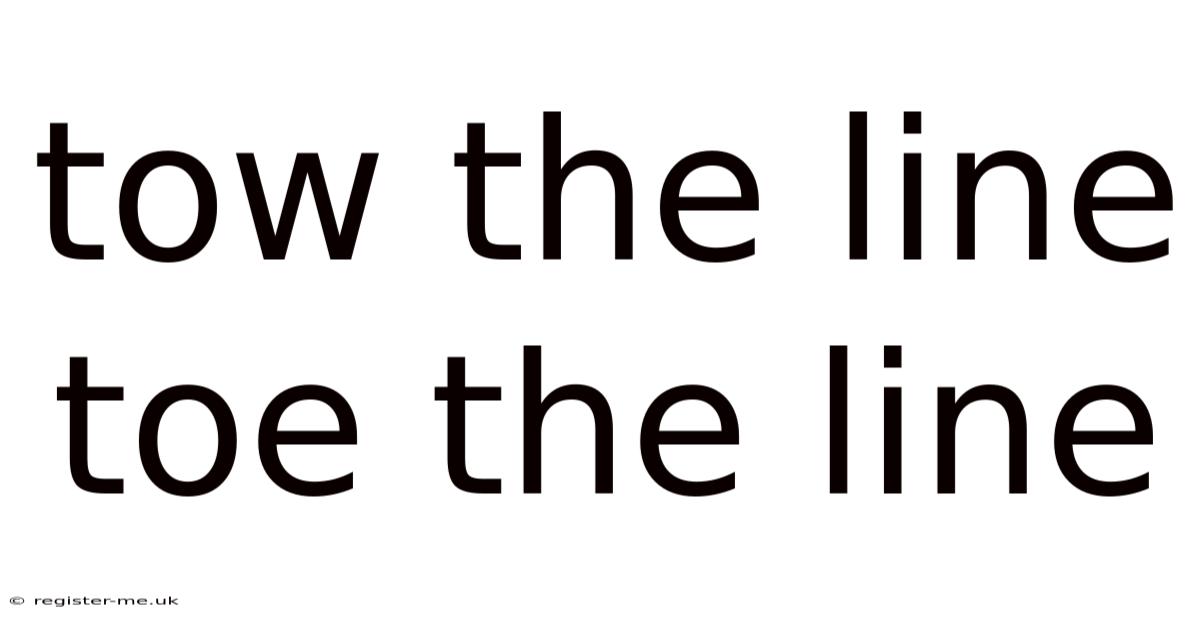
Understanding the Phrase "Toe the Line": Meaning, Origin, and Usage
The phrase "toe the line" is a well-known idiom that has been part of English vernacular for centuries. This leads to this article explores the correct meaning of "toe the line," its historical roots, common usage examples, and why it’s often confused with "tow the line. While its meaning is often misunderstood due to misspellings or confusion with similar phrases, it carries a significant connotation related to discipline, conformity, and adherence to rules. " By the end of this guide, you’ll have a clear understanding of how to use this idiom appropriately in both formal and informal contexts.
What Does "Toe the Line" Mean?
At its core, "toe the line" means to conform to rules, standards, or expectations, often in a strict or rigid manner. That's why it implies compliance with authority or following guidelines without deviation. Take this: in a workplace setting, an employee who "toes the line" adheres strictly to company policies, while a student who "toes the line" might follow school rules without question. The phrase can also suggest a lack of creativity or flexibility, depending on the context And it works..
The idiom is often used in sentences like:
- "The new manager expects all employees to toe the line, even if it means sacrificing innovation."
- "Athletes must toe the line during competitions to ensure fairness."
Origin and Historical Context
The phrase "toe the line" has a fascinating history rooted in physical discipline and military tradition. Because of that, one popular theory traces its origin to the 17th century, when sailors were required to stand at attention with their toes touching a line marked on the deck of a ship. This ensured uniformity and order during drills or inspections. Another theory links it to parliamentary procedures, where members of the House of Commons were expected to remain within designated lines while speaking to maintain decorum Not complicated — just consistent. And it works..
The earliest recorded use of the phrase appeared in the early 1800s, often in nautical or military contexts. Day to day, over time, it evolved into a metaphor for adherence to rules and social norms. The phrase gained further traction in the 19th century through literature and political discourse, cementing its place in modern English.
Common Usage Examples
Understanding how to use "toe the line" effectively requires recognizing its tone and context. Here are some scenarios where the phrase is appropriately applied:
-
Workplace Compliance:
"The company’s strict policies require employees to toe the line, leaving little room for personal initiative." -
Military or Sports Discipline:
"During boot camp, recruits learn to toe the line to build discipline and teamwork." -
Political Conformity:
"Party members who refuse to toe the line risk being sidelined by leadership." -
Academic Settings:
"Teachers often encourage students to toe the line when it comes to academic integrity."
In each case, the phrase emphasizes strict adherence to established norms or rules, sometimes implying a trade-off between conformity and individuality Worth knowing..
Why Do People Confuse "Toe the Line" with "Tow the Line"?
A standout most common mistakes is confusing "toe the line" with "tow the line." The latter is a frequent misspelling or mishearing of the former. Even so, "tow the line" is not a recognized idiom in English. The confusion likely arises because both phrases involve the word "line," but their meanings and origins are entirely different Simple as that..
- "Toe the line": To conform or follow rules strictly.
- "Tow the line": Not a valid phrase; possibly a mix-up with "toe the line."
While "tow" (meaning to pull something behind a vehicle) might seem logical in certain contexts, it does not align with the idiom’s historical or figurative meaning. Always use "toe the line" when referring to compliance or discipline Easy to understand, harder to ignore. No workaround needed..
Scientific and Psychological Perspectives on Conformity
The concept behind "toe the line" ties closely to psychological theories about conformity and social influence. Day to day, in the 1950s, psychologist Solomon Asch conducted experiments demonstrating how individuals often conform to group norms, even when those norms conflict with their own judgment. This behavior mirrors the idea of "toeing the line," where individuals prioritize social acceptance over personal beliefs.
From a sociological standpoint, strict adherence to rules can support order and efficiency, but it may also stifle creativity and critical thinking. Take this case: in educational systems that stress rote learning and standardized testing, students might "toe the line" without questioning the validity of the curriculum. Balancing conformity with innovation remains a challenge in many institutions Which is the point..
Real talk — this step gets skipped all the time.
FAQ About "Toe the Line"
Q: Is "tow the line" a correct phrase?
A: No. "Tow the line" is a common misspelling of "toe the line." The correct idiom is always "toe the line."
Q: What is the origin of the phrase?
A: The phrase likely originated in nautical or military contexts, where individuals were required to stand with their toes touching a marked line for discipline and uniformity.
Q: Can "toe the line" have a negative connotation?
A: Yes. While it often implies positive discipline, it can also suggest rigidity or a lack of flexibility, depending on the situation.
Q: How is "toe the line" used in literature?
A: Authors use the phrase to highlight themes of authority, rebellion, or social conformity. Here's one way to look at it: in George Orwell’s 1984, characters are forced to "toe the line" under oppressive regimes.
Conclusion
The idiom "toe the line" serves as a powerful reminder of the tension between individuality and conformity. That's why whether in historical military drills, modern workplaces, or literary works, it underscores the human tendency to follow rules—even when those rules may limit creativity or progress. By understanding its origin, meaning, and proper usage, you can communicate more effectively while avoiding common pitfalls like the misspelling *"tow the line.
In a world where adaptability and innovation are increasingly valued, knowing when to "toe the line" and when to challenge the status quo is a skill worth mastering. Use this phrase thoughtfully, and remember that sometimes, the most impactful changes come from those who dare to step outside the line Simple as that..
Contemporary workplaces illustrate this balance vividly, where agile methodologies reward experimentation yet still rely on shared protocols to maintain coherence across teams. That said, employees who recognize when precision matters and when improvisation invites growth can manage these expectations without alienating colleagues or sacrificing momentum. The same principle applies in civic life, where norms protect collective well-being but dissent refines policy and practice.
Digital environments further complicate the picture, as algorithms quietly redraw the boundaries that guide speech, visibility, and access. In practice, users routinely calibrate self-expression against invisible lines established by platform rules and social cues, often without realizing how frequently the line itself shifts. Awareness of these dynamics does not demand wholesale resistance; rather, it encourages mindful participation that respects community standards while preserving personal integrity.
When all is said and done, the enduring value of "toe the line" lies not in blind compliance but in conscious calibration. By tracing its journey from crowded decks and parade grounds into everyday language, we see a tool for reflecting on power, habit, and choice. Mastery of the phrase—and the judgment it represents—enables people to uphold necessary order and, when the moment calls, to redraw the line with purpose and care Easy to understand, harder to ignore..
The phrase’s historical roots in military discipline—a demand for synchronized movement and unwavering attention—reveal a fundamental human need for structure and predictability. This instinct, deeply ingrained, manifests in countless facets of society, from legal systems to educational institutions, shaping behavior and maintaining stability. That said, the very act of adhering to a line can stifle independent thought and discourage critical evaluation.
Consider the nuances of its application. Sometimes, “toe the line” represents a necessary constraint, a framework for collaboration and safety. In a complex surgical procedure, for instance, every member of the team must adhere to established protocols to ensure patient well-being. Conversely, the phrase can be wielded as a tool of control, subtly discouraging dissent or innovation by framing any deviation as unacceptable Worth knowing..
On top of that, the concept of a “line” itself is rarely fixed or absolute. A teacher might ask students to “toe the line” during a test, but that line shifts during a discussion, allowing for open debate and diverse perspectives. It’s often a negotiated boundary, subject to interpretation and redefinition based on context and power dynamics. Similarly, a manager might expect employees to “toe the line” regarding deadlines, yet recognize the value of flexible scheduling when unforeseen circumstances arise.
Contemporary workplaces illustrate this balance vividly, where agile methodologies reward experimentation yet still rely on shared protocols to maintain coherence across teams. But employees who recognize when precision matters and when improvisation invites growth can figure out these expectations without alienating colleagues or sacrificing momentum. The same principle applies in civic life, where norms protect collective well-being but dissent refines policy and practice.
Digital environments further complicate the picture, as algorithms quietly redraw the boundaries that guide speech, visibility, and access. Worth adding: users routinely calibrate self-expression against invisible lines established by platform rules and social cues, often without realizing how frequently the line itself shifts. Awareness of these dynamics does not demand wholesale resistance; rather, it encourages mindful participation that respects community standards while preserving personal integrity.
When all is said and done, the enduring value of "toe the line" lies not in blind compliance but in conscious calibration. Which means by tracing its journey from crowded decks and parade grounds into everyday language, we see a tool for reflecting on power, habit, and choice. Mastery of the phrase—and the judgment it represents—enables people to uphold necessary order and, when the moment calls, to redraw the line with purpose and care But it adds up..
